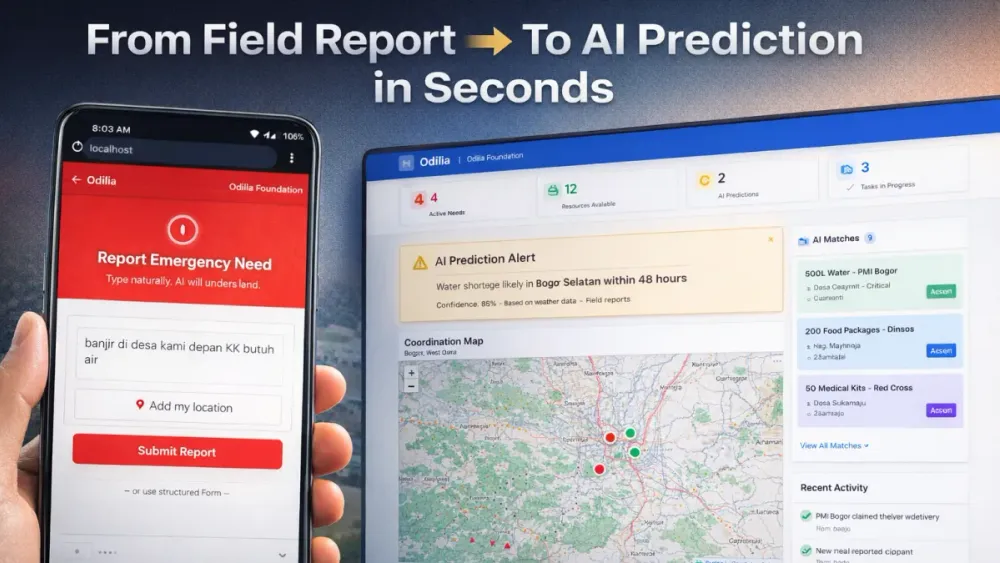
AIdeas: Odilia - Turning Disaster Response from Reactive to Predictive
An open source AWS powered platform that predicts humanitarian needs before they are reported, enabling proactive coordination and faster response.
My Vision
By the time a field worker reports "we need water," it may already be too late. When disasters strike, the same pattern repeats everywhere: fragmented information, reactive response, coordination chaos.
Built for AWS AIdeas, Odilia is an open source humanitarian coordination platform powered by AWS. The killer feature: AI that predicts needs before they're reported. Instead of waiting for field workers to report "we need water," Odilia analyzes weather data, field reports, and historical patterns to predict: "Water shortage likely in this area within 48 hours. Pre-position resources now."
That 48 hour window can mean the difference between control and collapse. The platform is designed to be self-deployed. Any government, NGO, or community can run their own instance with their own branding.
What's Missing
- 01No tool predicts needs before they're reported
- 02No real time matching of resources to needs
- 03No unified view across organizations
- 04No field friendly mobile interface
Why This Matters
In November 2025, Cyclone Senyar triggered catastrophic floods and landslides across Sumatra, Indonesia. As of December 29, 2025, official data reports 1,140 fatalities with 163 still missing, and 399,200 people displaced across 52 districts in three provinces.
Indonesia's National Disaster Management Agency (BNPB) highlighted key weaknesses in the response: "inadequate logistics, insufficient risk mitigation and emergency response systems, weak disaster management institutions and a lack of coordinated field data."
This isn't unique to Indonesia. NetHope's global research confirms: "There is a general sense that a centralized information system for crisis data sharing is absent. Every time a crisis occurs, responding organizations form a temporary coalition. This ad-hoc coordination is not effective."
The same failures happen in hurricanes, earthquakes, wildfires, and refugee crises worldwide.
Existing tools like UN OCHA's Humanitarian Data Exchange (HDX) are data repositories, the platform's goal is "to make humanitarian data easy to find and use for analysis," not operational coordination. Logistics software like HELIOS tracks supplies, but research found that "critical decisions such as inventory management, supply planning, routing and scheduling are not addressed." And as Fritz Institute noted, "the majority of field logisticians still use spreadsheets or, equally likely, a pencil and paper to manage incoming supplies."
How It Works
Field worker submits a report via mobile (free text or structured form, any language). Example: "banjir desa kami 200 KK butuh air"
Amazon Bedrock parses the text and extracts: need type, urgency, location, affected count
Data stored in DynamoDB, displayed on live coordination dashboard
AI analyzes patterns across reports combined with weather data and geographic clustering
Predictive alert generated: "Water shortage likely in [area] within 48 hours"
Coordinators match available resources to predicted needs and pre-position before shortage peaks
All processing happens serverless on Lambda, keeping costs minimal and scaling automatically during crisis surges.
Architecture Decisions
HTMX over React: Humanitarian field workers often have slow 2G/3G connections. HTMX is 14kb vs React's heavy bundle. No build step means faster deployment.
Self-deployable: Organizations configure their instance with one setup page, name, logo, focus area on map. The platform adapts to their branding.
Two input modes: Field workers can use structured forms OR free text input in any language. AI parses messy text like "banjir desa kami 200 KK butuh air" into structured data.
AWS Free Tier compliant: Lambda, DynamoDB, API Gateway, Cognito, Amplify, all within free tier limits for MVP.
Expected Cost
AWS Free Tier covers development and small pilots. At moderate scale (1,000 reports/month), estimated cost is $20 to $50/month using Lambda, DynamoDB, and Bedrock. Accessible by design.
What I Learned
The problem is universal, not local: I started thinking about Indonesia floods. Research showed the exact same coordination failures happen in every disaster globally. This shifted Odilia from a local tool to a global platform.
Prediction is the killer feature: Many tools help coordinate AFTER needs are reported. The real value is predicting needs BEFORE they peak. By the time infrastructure fails, resources should already be in position.
Open source builds trust: Having worked in the public sector, I know governments and NGOs are cautious about platforms that control their data. Making Odilia self-deployable and open source removes that barrier. They own their data, they run their instance.
Simple beats sophisticated: Field workers need something that works on a slow phone connection. HTMX + plain HTML beats a fancy React app that won't load on 2G.
Why This Matters Now
Disasters will increase.
Climate volatility will increase.
Displacement will increase.
But coordination doesn't have to remain reactive.
If we can predict infrastructure failures, we can predict humanitarian shortages. And if we can predict shortages, we can save lives before the crisis peaks.